Adrienne Gruber – “Tens of Thousands of Wounds”
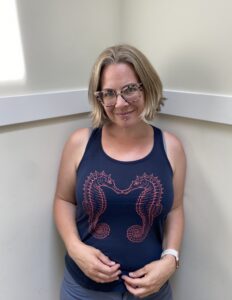 “Tens of Thousands of Wounds” stood out with its rawness and immediacy, and its strong, distinct voice. This stunningly written essay offers an understated, perceptive, and moving account of chaos and resilience through the unique challenges of midlife: the delicate balance we try to achieve between caregiving for elderly parents and raising young children, and the things we must do to survive it.
– Contest Judge Ayelet Tsabari
Tens of Thousands of Wounds
“So where do you want it to go?”
The tattoo artist at the shop on Granville Street in downtown Vancouver is holding a plastic strip with the words I’ve selected, a statement I’ve mumbled to myself so many times it rolls off the tongue as though I invented it. A quote that is almost cliché, something that, later, when friends read it along the inside of my arm, they will ask if it’s a quote from a poem I’ve written – I’ll swallow hard when I think of this, because the idea of quoting myself is deeply embarrassing.
The tattoo artist used to write poetry too, he tells me, back when he was in art school. Didn’t we all used to write poetry at some point in our lives? I did for years and was sure I could never write in any other genre, but here I am now, invested in long lines, in spiraling, squirming prose. When I sit down to write poetry, it doesn’t stick. The language feels too sparse. I can’t break my lines apart or use the white space of the page. Poetry confounds the message – it is lost in metaphor, and I can’t allow myself to be lost anymore.
When I close my eyes in preparation for the needle, I see my mum in her white nightgown with the embroidered flowers, a nightgown so old and ragged it’s practically transparent, her swollen legs stretched out, feet resting on my dad’s skinny legs as they sit together on their old couch watching TV, which is what they do when they sit together, and they are always sitting, always together on that couch.
The couch itself has spots of black mould on the legs, partly because we live in a temperate rainforest climate and mould grows easily, but partly because my parents haven’t cleaned anything of theirs in years. Sometimes cleaners come and the floor gets vacuumed, and the bathtub gets scrubbed, but when my mum cancels the cleaners due to panic about money, the black mold creeps back into their toilet bowl and the bathroom becomes home, again, to a faint cloud of urine.
They weren’t always like this; succumbed to mental illness and cognitive decline. They had careers and friends and three children, my brother, my sister, and me. They hosted holiday dinners and potluck barbecues and tacky-shorts parties in the summer. Mum gardened in the backyard and Dad maintained the pool we swam in as kids. They came to my basketball and softball games, my sister’s music concerts, and they let our friends come over and stay for as long as they needed to. They were a safe space. At least that’s what I thought.
The paper that covers the table crinkles as I shift position, and I place my right arm down on the cushion. The tendons and veins in my wrist pop up when I curl my hand into a fist. I read once that the tattooing process creates tens of thousands of tiny wounds in a deep layer of skin. The procedure pushes the immune system into overdrive, with the body immediately stepping up to remove the foreign substance (the ink) and heal the new wounds. But the ink is injected into the dermis, the delicate layer under the epidermis, and the dermis holds the trauma when the ink is infused onto the skin.
The tattoo artist runs a solution across my inner arm and sweeps a razor over it to remove any fine hairs. He rubs an alcohol swab over the area to sterilize it before gently pressing the plastic strip of letters against my skin. He peels the strip away, and there are the four words I have chosen to take up residence on my forearm, where every day when I’m teaching or driving or vacuuming or typing or making school lunches or reaching for Dennis beside me on the couch, I’ll see the phrase that is supposed to help me remember.
It’s chaos, be kind.
It’s a quote from the comedian Patton Oswalt’s stand-up special Annihilation. Except it’s not really his; it’s his dead wife’s, something she used to say before she died in her sleep from a combination of prescription drugs and an undiagnosed heart condition. She used to argue with Oswalt about the existence of God. He would ask her if there wasn’t some small part of her that believed in something bigger than herself, bigger than humanity. She would shake her head and say, Nope, it’s all random, it’s all terrible, we just have to be kind to each other. It’s chaos, be kind. Oswalt ends his comedy special with these words, a prayer for the audience to remember, a mantra to take with them as they stumble through their grief, their pain, their shit. It’s chaos, be kind.
It takes days for me to gather enough emotional strength to walk down the stairs to the mudroom and knock on the door to the basement suite of my house where my parents live. I never know what the smell will be like, but often it is the sour stench of unwashed bodies, of clothing that has been worn for days, the first real indication that we are dealing with damaged brain cells that refuse to die. It is not just the smell that violates my senses, it’s the dark energy of untreated mental illness and the staunch denial of that mental illness.
Mum will be resting on the couch when I come in, and sometimes she’ll turn to me with a wide cheek-splitting grin as though she is on uppers, unaware that mucus is oozing from her puffy eyes and her skin is beige from staying inside all day every day. Some moments she is lucid, but often I find her moaning in panic, her brain a cognitive maze, a neurological puzzle distorting reality. I read recently that studies done on mice found that older adults who suffer from extreme anxiety had an increased risk of developing dementia. It is difficult to know where the mental illness stops and the cognitive decline begins.
“Empathy can be a hole through which one falls into despair,” writes Heather Christle in The Crying Book. I’ve been reading her book while trying to extract myself from this caregiving situation I find myself in and realizing that, while I want to be kind to my parents, I want to help them, I cannot stay in the kindness without losing myself to despair.
Over the last decade I’ve witnessed the steady decline of the humans who made me. During the same decade, I’ve given birth to three humans. The present feels slippery and evasive, impossible to navigate. Sometimes despair manifests as sadness and it sits as simple discomfort in my organs, a pressure, like a hand squeezing my lungs. Often it exists as small nuggets of irritation that rise in my throat, grating my esophagus. Most days the sadness sinks deep in my bones, in the spongy tissue of marrow itself, where new blood cells are produced. I learn that bone marrow is primarily located in the ribs, vertebrae, sternum, and the bones of the pelvis, these four areas gripping sadness. I can feel it – the tightness in my rib cage, the way that tightness travels down my vertebra and settles into my pelvis where three births have permanently bruised the bone. My sadness is planted in me like a fetus, gestation period: unknown.
“It’s a great line,” the tattoo artist says, as he picks up his needle and prepares the ink. “Did you make it up yourself?”
I consider telling him the story behind the line, why it means so much to me, how the first time I heard it I sat up straight and the hairs on the back of my neck prickled and tears stung behind my eyes. This was long before the chaos hit with its full capacity, when I only had two children sparring for my attention, and my parents were mostly healthy and independent, though there were signs of that chaos lurking. This was long before the endless hours in the emergency room at Lion’s Gate hospital, when my dad’s diabetes was out of control – his low blood sugar seizures when he forgot to eat – or when my mum took too much Lorazepam because ‘she didn’t think it would do anything’ for her endless, overwhelming anxiety.
I thought about telling the tattoo artist about that first year of my teaching career, the same year that Annihilation was released on Netflix, how a teacher I didn’t know gave a retirement speech at the year-end staff breakfast and wept to all of us, his colleagues who had held him through thirty years of teaching, and said “you have loved me into existence.” How two years later that teacher died of cancer, how those two quotes are burned into my brain, and having one of them on my skin forever was part of my plan to keep me from sinking too deep, from forgetting how I need to conduct myself, from ignoring the depth of my sadness, but also holding onto the depth of possible joy.
But I don’t tell him any of this. I simply shake my head. “No, it’s just a quote I like.”
I don’t tell him I’ve been sad every single day for months, that it’s come to the point where I’ve resolved within myself that I will probably be sad forever. The sadness itself is like an organ growing inside me, its sole purpose to gestate and nourish the grief, much like a placenta is generated by the body itself, its only purpose to feed and mature the developing fetus. The word placenta is Latin for ‘cake’ and German for ‘mother cake’. Grief comes from the Latin word ‘gravare,’ meaning heavy. The word sadness originally meant ‘fullness.’ Once I was full of cake. Now I’m just full of a heaviness that won’t leave. After my first daughter was born, my doula took my placenta home and dried it out in her oven, then ground it up into powder and encapsulated it. She brought the pills to me, and I diligently swallowed two a day until I had absorbed the entire organ back into my body. It was meant to prevent post-partum depression caused by hormone fluctuations. Now, there is nothing I can swallow to alleviate my grief.
The tattoo artist lowers his needle into the ink and grips my forearm into position. The familiar pricking of the skin on my inner arm reminds me of the few times I self-harmed as a teenager, desperate for someone to notice the pain I was in. This feels different, though – a way to extract that same emotional saturation and bring it to the surface. The hot burning sensation is so satisfying I smile.
“I forgot how good this feels.”
“It’s addictive, isn’t it?”
We sit in silence as he goes over and over each letter with the needle, occasionally pausing to wipe away ink and fluid. The letters slowly fill in, and by the end have begun to puff up slightly, enraged by this intrusive assault – the sharp liquid pain trapped just under my skin, those tens of thousands of wounds, weeping to the surface.